


Carbon markets keep debating price when the real gap is trust

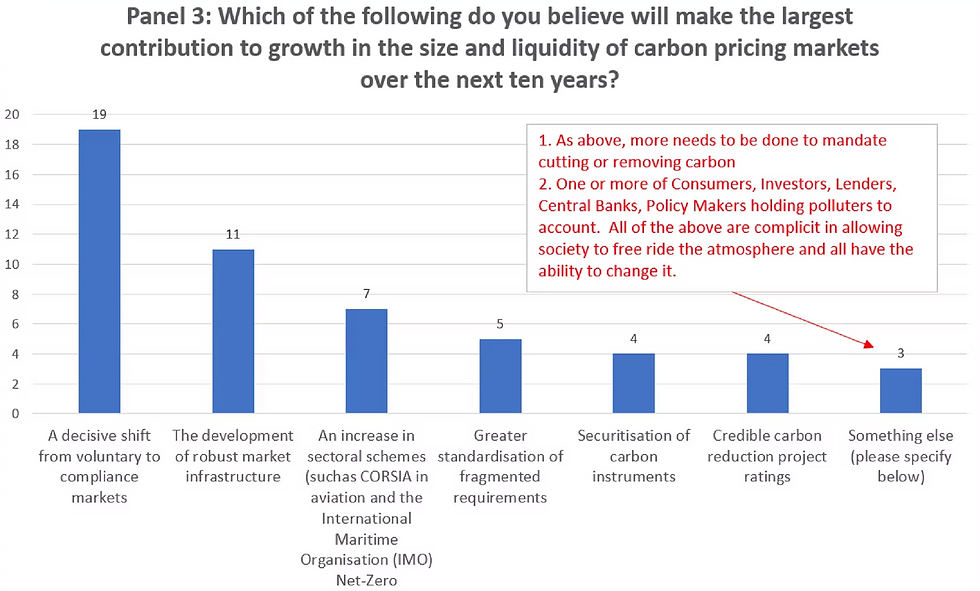
A majority of the audience at the Future of Finance Carbon Credits event picked a shift to compliance markets as the biggest driver of growth in carbon pricing.
Securitisation is a potential alternative to the present packaging and distribution of carbon emissions, and can draw on an established modus operandi.
An absence of market infrastructure remains a weakness of carbon pricing markets, but there is no confidence that tokenisation offers a plausible way forward.
Other techniques for increasing activity in a market that is still rich in growth potential include yield-based products and making ownership of carbon mandatory.
Carbon should, by the arithmetic of global emissions alone, be a market at least half the size of a US$3 trillion a year oil market. It is instead worth something closer to 2 per cent of it. That gap is not a pricing anomaly waiting to correct itself. It is the visible symptom of a fragmented market (the latest World Bank report on the carbon pricing markets counted 121 separate carbon pricing instruments, made up of 47 carbon taxes, 40 emissions trading schemes and 34 carbon credit markets, spread across 87 jurisdictions) that encompasses only a third of global emissions (70 per cent occur outside any pricing mechanism). Worse, the carbon pricing markets have failed to develop the financial incentives, the market infrastructure and the public trust that would enable them to reach their full potential.
So what can change this dismal trajectory? One idea is securitisation. Carbon credits could be wrapped into regulated securities using decades-old legal infrastructure, private placement options under Rule 144A and Regulation S in the United States, tracked with standard securities identifiers such as CUSIPs and ISINs rather than carbon credit registries, and held at a central securities depositories (CSDs) the way that tradeable financial instruments such as equities and bonds are today. On this view, the carbon market's growth problem is not carbon-specific at all: it is a standardisation, infrastructure and trust problem that securities law has already solved for other asset classes, and there is no reason it would not work for carbon as well.
Securitisation does raise one potential problem. If underlying project-level credits are bundled into securitised, tranche-like structures, it could create the carbon pricing market equivalent of sub-prime mortgage risk. Project-level assessments might mean little once an asset is bundled up with other projects and repackaged. The non-fungibility of carbon projects means any securitised carbon product is only as reliable as the diligence performed on the projects it encompasses. That said, securitisation will transfer diligence responsibility to a named, accountable issuer rather than diffuse it across issuers, registries, trading platforms and other components of the carbon pricing markets. This will provide a measure of protection against the risk that securitised carbon instruments degenerate into the equivalent of the structured credit markets of the pre-crisis period.
Another reason securitisation might work better than the current tendency to treat carbon as a commodity is the non-fungible nature of carbon risks. A tonne of carbon in one project is not interchangeable with a tonne in another project, so it is not a true commodity like copper or gold or (within limits) a barrel of oil.
Indeed, the absence of a single global carbon price reflects the range of national and sectoral factors - most obviously, natural endowments, industrial policy and protectionism – that govern the price of carbon in different contexts. One firm that sought to standardise industry jargon found, after four years of work, it had built a glossary of 4,000 words. This is a concrete measure of how much basic definitional work the carbon market has still to complete. An industry that cannot agree on its vocabulary will struggle to converge on a single price for carbon.
Another idea to spark activity in carbon pricing markets is tokenisation. However, efforts to tokenise existing carbon credits have failed. In the poll of the audience on how to make the carbon pricing markets grow, tokenisation attracted not a single vote. The objection was that tokenisation adds another layer of complexity to an already complicated industry. Buyers of carbon are struggling to understand their own emissions and which specific credit can best mitigate them. Irrespective of the benefits of tokenisation in enhancing transparency, and eliminating greenwashing and double-counting, introducing blockchain technology and terminology into the conversation risks overwhelming rather than reassuring the buyer.
The path to tokenising carbon was further obstructed by efforts to move existing, already-issued credits onto a blockchain network. By trying to tokenise credits that are trading already, instead of building tokens into a carbon project at its inception, innovators undermined perceptions of what the technology can usefully do. Retrofitting a new technology layer into an established set of carbon credits is much harder to execute than embedding tokenisation into a project’s data at the point where credits are first issued.
The general scepticism about the utility of tokenisation was offset by one instance of a useful application. An environmental asset authenticator, registry, and marketplace is using blockchain technology as an internal tracking and audit mechanism in its transfer agency role, because it provides carbon pricing markets with functionality similar to securities identifiers. In other words, tokenisation technology is useful in carbon pricing markets as invisible plumbing. It is less effective as part of a carbon sales pitch. Technology that works is helpful; technology that has to be explained simply adds friction to an already difficult conversation.
Hopes for a significant upsurge in activity through bi-lateral sales and purchases of carbon under Article 6.0 of the Paris Agreement - Article 6.2 empowers sovereign states to exchange Internationally Transferred Mitigation Outcomes (ITMOs) while Article 6.4 encourages companies to buy credits from high integrity projects - are yet to be fulfilled, partly because Articles 6.2 and 6.4 are not yet fully in place. However, bi-lateral agreements between countries are being signed already, led by Singapore (32 signed) and Switzerland (19 signed). Some emerging market governments are equally enthusiastic because they see Article 6.0 as a source of capital investment.
Emerging markets act for reasons which differ from those of developed economies. The experience of Vietnam suggests national incentives, not global standard-setting, will shape growth in carbon pricing markets. Vietnam holds the world's second-largest reserves of rare-earth mineral, which are much in demand in western Europe and North America. This gives the Vietnamese government leverage in negotiations with Europe over market access under the EU’s Carbon Border Adjustment Mechanism (CBAM). If CBAM is economic pressure exerted in the guise of climate policy, possession of rare earth minerals gives countries such as Vietnam a means of resisting rather than simply absorbing the cost of CBAM.
Another motor of increased activity is to turn carbon into a yield-producing investment. One carbon pricing platform is re-deploying the money market assets that back Stablecoins into carbon assets, creating blended investments that turn carbon projects such as data-centres and renewable energy products into high yield investments. The returns are high enough to compete with conventional money and bond market yield. This is promising. If carbon exposure can be sold as a yield-enhancement product, and not solely as a climate purchase, it will help the market grow.
A further idea to increase activity is the efforts being made to increase the respectability and tradeability of carbon credits by issuing ratings. These are not proving effective. Most carbon projects behave more like equity than debt, since they typically lack the predictable cash flows that traditional agencies such as Moody's and S&P require to rate a conventional financial instrument. Carbon ratings currently function more as valuations of expected credit quality than a credit ratings per se. The carbon pricing markets have not been explained this distinction well.
One final method of increasing issuance and trading activity in carbon pricing markets is for governments to make ownership of carbon mitigation assets mandatory. If every emitting business had to hold a carbon asset, on pain of being unable to operate, it would force scale into existence overnight by making participation compulsory rather than optional. However, such a drastic step would be difficult to implement politically in one country, let alone on a global scale. As a way forward, coercion is less promising than increasing corporate incentives to mitigate emissions, either by increasing the costs of non-investment or improving the revenues of investment. Carbon credits will scale when they stop being a sign of corporate virtue and start being priced, rated, settled and held in the same way as any other asset.


