


Carbon markets shrink while carbon costs quietly become unavoidable

The voluntary carbon credit market has contracted, but the residue that survived is more disciplined than before.
Europe's CBAM and Methane Regulation are functioning as de facto tariffs, with costs expected to fall on consumers.
Verified emissions data, not climate intent, is becoming the currency that determines which exporters gain or lose market access.
Bilateral offtake structures are absorbing activity that public carbon credit markets can no longer reliably price.
A market can shrink and become more credible at the same time. That is the uncomfortable idea running through the first panel at Carbon Credits 2026, held on 10 September 2026, where the discussion moved from the fate of voluntary carbon credits to the harder question of carbon costs. The panel, titled From Carbon Credits to Carbon Costs: How Externalities Are Being Priced into Trade and Supply Chains, explored how measures such as the EU’s CBAM are turning carbon into a factor whose cost must be managed aggressively.
Registrants, polled on what had done the most damage to carbon pricing markets over the past three years, pointed to loss of integrity in the voluntary carbon markets, which had become associated with double counting and greenwashing. They thought this was more important than the hostility to carbon pricing of the Trump administration (see Chart 1). A smaller group blamed certification agencies for relying on discredited methodologies. One registrant added a sharper note: carbon pricing works, when it works, because it is an economic mechanism, not an environmental one. The act of paying for emissions, not the underlying science, disciplines behaviour.
Chart 1
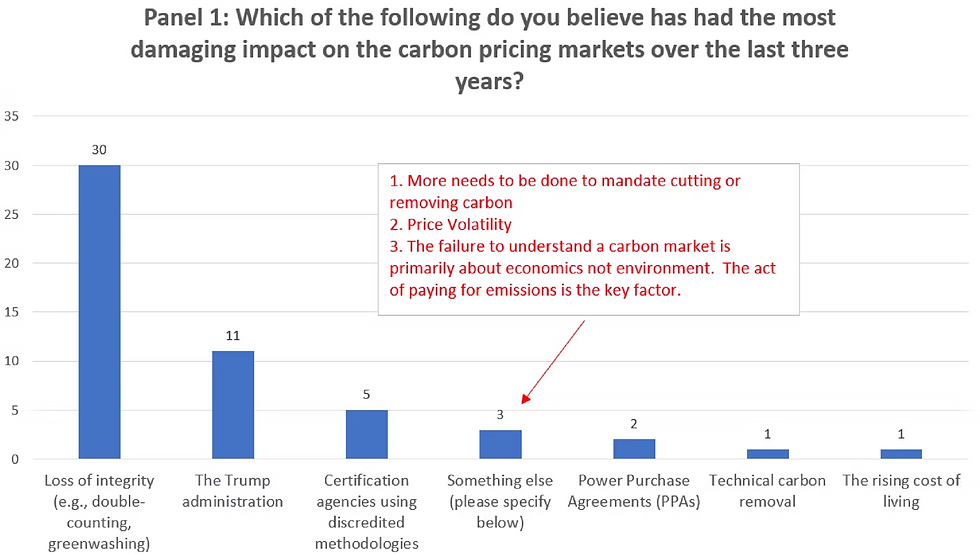
That framing matters because it reorients the entire discussion from reducing carbon footprints to paying for emissions. If carbon pricing is fundamentally about economics rather than the environment, then its credibility problem is not primarily a scientific one. It is a market structure problem. The EU has responded not by fixing the voluntary market but by building a parallel, harder-edged system around it.
The clearest expression of that system is the EU's Carbon Border Adjustment Mechanism (CBAM), which has moved from a reporting requirement into full implementation in 2026. It applies to carbon-intensive industries (electricity, aluminium, cement, fertiliser, hydrogen, and iron and steel) and uses embedded carbon metrics to price the emissions incorporated in imported goods. Pricing data cited during the discussion showed the mechanism adding roughly €75 per tonne to typical unrolled aluminium imports in the first quarter, rising to €140 per tonne for Chinese-origin material and falling to €36 per tonne for Turkish material. The spread is not incidental. It is the mechanism doing what it was designed to do: discrimination by verified emissions intensity.
Speakers agreed that, while importer are legally liable to pay the cost of CBAM, the real cost would fall on consumers. One speaker argued consumers would in fact experience two cost shocks because free emissions allocations for domestic EU producers are being phased out at the same time as CBAM raises import costs.
CBAM is also encouraging countries with heavy trade exposure to the EU to build their own domestic carbon pricing mechanisms. They have a straightforward incentive to do so: it keeps carbon pricing revenue at home rather than hand it to Brussels. Turkey was cited as furthest along, with Brazil and Mexico following. Whether this counts as a policy success is contested. It could lead to re-industrialisation within the EU or simply relocate revenue collection without meaningfully cutting emissions.
A parallel EU Methane Regulation was seen in similar terms to CBAM, requiring importers of oil, gas and coal to report, and eventually manage, methane intensity, with penalties reported at up to 20 percent of turnover for non-compliance. The economic case for prioritising methane is strong. One speaker cited International Energy Agency (IEA) figures suggesting around 74 percent of global oil and gas methane emissions are abatable at €10 per tonne or below, versus €100-300 per tonne for engineered carbon capture solutions in Europe. The implication is that methane abatement offers far more emissions reduction per unit of capital than many higher-profile decarbonisation technologies, even if it lacks their public appeal.
That appeal gap is not incidental to the carbon pricing markets. The forestry and nature-based projects that populated the early years of the voluntary carbon credit markets continue to dominate public perception of carbon-pricing markets, yet compliance-based schemes are concentrated in energy and heavy industry are more effective. Audience contributors argued this mismatch is itself a source of confusion, since criticism aimed at forestry and nature projects gets applied, often unfairly, to a compliance market built on entirely different methodologies and sectors.
The shift towards compliance based carbon pricing seems unstoppable. The two major voluntary carbon registries agreed in November 2025 that only sovereign‑authorised outcomes with Letters of Authorisation (LOAs) and Corresponding Adjustments (CAs) have standing as international mitigation outcomes. Speakers framed this as the market moving away from voluntary self-governance and self-regulation towards a more legalistic, state-anchored framework.
Industries are creating their own standards in alignment with the shift. The Carbon Offsetting and Reduction Scheme for International Aviation (CORSIA) has now fully aligned with Article 6 by requiring LOAs and CAs for eligible units. Airline compliance data cited during the discussion showed under one million tonnes cancelled against obligations, against a provisional supply pool of around 170 million tonnes, with roughly 15 months remaining before the end of the scheme's first compliance phase. Elsewhere, pricing for broadly comparable credits was described as ranging from around US$11 to more than US$20 per tonne, reflecting buyer preference for regionally sourced projects and inconsistent third-party ratings rather than a single clear price signal.
A practical response to price instability has been a quiet migration of activity into bilateral offtake agreements, or long-term contracts in which a buyer commits to purchase a future stream of carbon credits at a pre-agreed price. Rather than relying on public exchanges to establish a credible price, financiers are increasingly structuring deals where the underlying project - often a methane abatement infrastructure in an emerging market - has to work out its own economics, with any resulting carbon treated as unpriced. It suggests the carbon pricing market in its current state cannot be trusted to price the credit component reliably enough to underwrite capital expenditure.
None of this settles a deeper question raised from the floor: whether carbon pricing exists to drive an actual transition away from fossil fuels, or simply to reward whoever prices carbon most effectively. Speakers acknowledged that carbon-linked mechanisms have historically helped subsidise renewables, and that fossil fuel demand is expected to persist at significant volume for decades. That is an uncomfortable but coherent position: transition finance and continued hydrocarbon investment are not necessarily contradictory in the near term, provided the accounting for the carbon is verified rather than assumed.
Indeed, verified emissions data, not stated climate intent, is becoming the input that determines market access and input cost. The CBAM’s current exclusion of Scope 2 emissions leaves a structural gap in the data that is needed to verify carbon emissions. Article 6.0 may be the ultimate standard setter but it is not fully implemented. It will take time also for the various carbon pricing mecahnims – including offtake agreements – to interoperate. Until these changes are complete, corporate finance and procurement teams must function without a clean, reliable global carbon price. Their best priority is to build the data plumbing that can collect and prove, tonne by tonne, exactly whose emissions are being paid for.


